
How to Choose the Right Size Sofa for Your Space (part 1)
A Designer’s Guide to Finding the Perfect Fit for Comfort, Style, and Everyday Living
Your sofa is more than just a piece of furniture.
It is where family gathers after a long day, where friends settle in over coffee, where movie nights unfold, and where quiet moments happen with a good book or a favourite blanket.
Because a sofa is often the largest piece of furniture in your living room—and one you will likely enjoy for many years—choosing the right one deserves more thought than simply finding a style or fabric you love.
The most successful rooms are not created by choosing the biggest sofa that fits or following the latest trend. They are created by selecting furniture with the right proportions for the space and the people who use it.
A sofa that is too large can make a room feel crowded and difficult to move through. A sofa that is too small can leave a room feeling disconnected and unfinished. Even a beautiful sofa may not feel comfortable if the seat depth or height does not suit your lifestyle.
The good news?
Choosing the right sofa size does not have to be complicated.
With a little planning and an understanding of sofa dimensions, you can select a piece that feels balanced, comfortable, and perfectly suited to your home.
At Addie Birch, we believe furniture should not only look beautiful—it should support the way you live. This guide will help you understand the measurements that matter, how to plan your space, and what to consider before making one of the most important furniture decisions in your home.
Why Sofa Size Matters More Than You Think
When homeowners begin searching for a new sofa, the first things they often consider are:
- Colour
- Fabric
- Style
- Shape
These are important, but experienced designers begin somewhere else.
They consider:
How will this sofa function in the room?
A well-designed living space considers:
- How people move through the room.
- How many people need seating.
- Whether the sofa is used for entertaining or everyday relaxation.
- How the furniture relates to windows, architecture, and other pieces.
- How comfortable the sofa feels after hours of use.
A sofa establishes the scale and feeling of the entire room.
When the size is right:
✓ The room feels balanced.
✓ Furniture feels intentional.
✓ Walkways feel natural.
✓ Conversations happen more comfortably.
✓ The space feels welcoming rather than crowded.
Designer Insight: Bigger Is Not Always Better
One of the most common mistakes homeowners make is purchasing the largest sofa that will fit along a wall.
While a large sofa may seem luxurious, it can overwhelm the room and leave little space for movement.
Professional designers often allow some breathing room around furniture. A small amount of visible space around a sofa can make the entire room feel larger, lighter, and more thoughtfully designed.
Good design is not about filling every inch.
It is about creating balance.
Before You Shop: Understand How You Live
Before looking at sofa styles, think about how your household uses the space.
Ask yourself:
Is this your everyday living room?
If so, comfort and durability may be your highest priorities.
Do you entertain often?
You may want a sofa arrangement that encourages conversation and allows multiple people to sit comfortably.
Does anyone enjoy lounging?
A deeper sofa with generous seating may be ideal.
Are children or pets part of your household?
Fabric selection, cushion construction, and durability become especially important.
Do different people have different comfort needs?
Seat depth and height can make a significant difference between a sofa that looks beautiful and one that feels comfortable every day.
There is no single perfect sofa size.
There is only the right sofa size for your home and your lifestyle.
Understanding Sofa Measurements
Furniture specifications can sometimes feel overwhelming because there are several different measurements to consider.
Understanding the basics will make comparing sofas much easier.
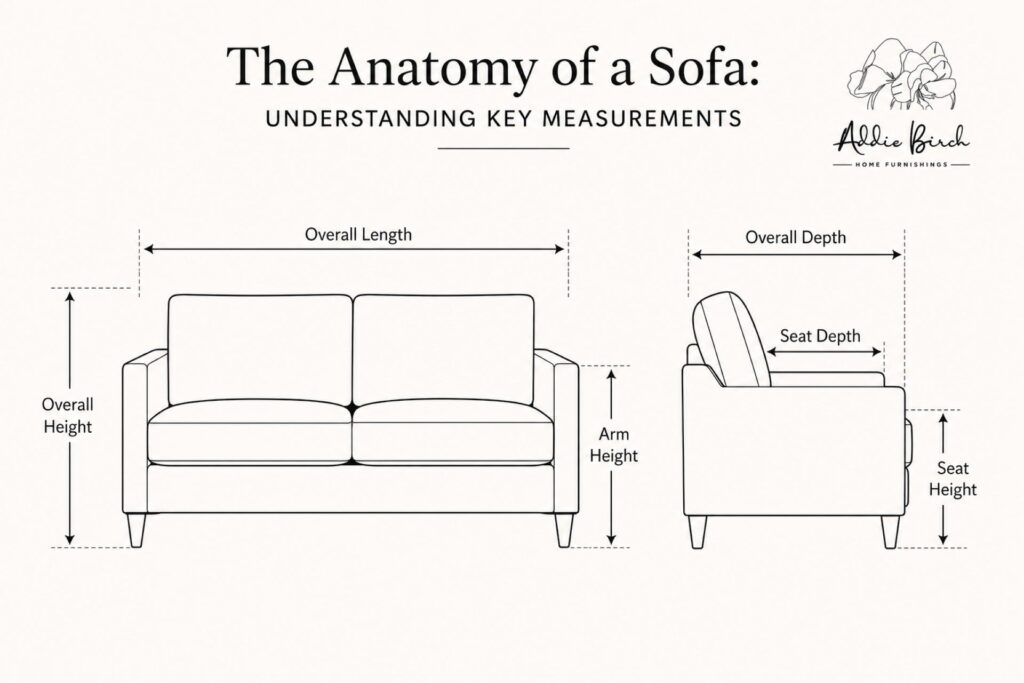
Primary Sofa Measurements
Sofa Length
Sofa length measures from the outside edge of one arm to the outside edge of the opposite arm.
This measurement determines how much seating the sofa provides and how much visual space it occupies.
Most standard three-person sofas range between 71 and 86 inches, with 84 inches being one of the most common sizes.
General Sofa Length Guide
| Sofa Length | Best Suited For |
|---|---|
| 48-72 inches | Love seat, made for small spaces or one to two people. |
| 70–80 inches | Condos, apartments, smaller living rooms |
| 72-96 inches | Standard 3 seater for family rooms, fitting medium rooms. (84″ is most common) |
| 90-118 inches | Large 4 seater for larger living spaces and open-concept homes |
| 94-156+ inches | Sectionals for Great rooms and expansive spaces |
The best sofa isn’t necessarily the longest one—it’s the one that’s proportionate to the room around it. Professional designers consider how the sofa relates to the entire space, including coffee tables, accent chairs, walkways, and surrounding architecture. Leaving a little breathing room around your furniture often makes a room feel larger, more elegant, and more comfortable to live in.
Sofa Depth
Sofa depth measures from the front edge of the sofa to the back.
Most sofas range between 32 and 40 inches deep, with approximately 35 inches considered standard.
Depth affects both comfort and the overall feeling of a room.
Shallower Sofas
A shallower sofa typically creates:
- A lighter, more open appearance
- A tailored, refined look
- An upright, supportive sitting position
- Better conversation seating
- More visual space in smaller rooms
They work well in:
- Condos and apartments
- Smaller living rooms
- Formal living rooms
- Conversation areas
- Homes with narrower floor plans
- Modern, Scandinavian, and transitional interiors
Deeper Sofas
A deeper sofa typically creates:
- A relaxed, casual atmosphere
- A cozy, inviting feel
- A luxurious, lounge-like experience
- A more substantial visual presence
- Greater comfort for stretching out
They work well in:
- Family rooms
- Media and TV rooms
- Large open-concept spaces
- Great rooms
- Homes with taller occupants
- Contemporary and relaxed interiors
Designer Insight
A sofa’s depth influences more than comfort—it shapes the entire personality of a room. Shallower sofas encourage conversation and create a lighter, more tailored look, while deeper sofas invite you to relax, stretch out, and stay awhile. Neither is better than the other; the right choice depends on how you want your space to feel and how you live in it.
Sofa Height
Sofa height measures from the floor to the highest point of the back. Most sofas range between 26 and 36 inches high.
While height may seem like a small detail, it has a significant impact on both the look of your room and the comfort of your seating. The right choice depends on your home’s architecture, your personal style, and how you use the space.
Lower-Back Sofas
Lower-back sofas often create:
- A clean, modern aesthetic
- Open sightlines that make a room feel larger
- A lighter, more spacious appearance
- A relaxed, contemporary feel
They work well in:
- Smaller living rooms
- Open-concept homes
- Spaces with large windows or scenic views
- Modern, Scandinavian, and minimalist interiors
- Rooms where maintaining an open, airy feeling is a priority
Higher-Back Sofas
Higher-back sofas often create:
- A cozy, inviting atmosphere
- Greater back and shoulder support
- A classic, timeless appearance
- A stronger visual presence that anchors larger spaces
They work well in:
- Family rooms
- Traditional and transitional interiors
- Homes with higher ceilings
- Larger living rooms and great rooms
- Spaces where comfort and extended seating are priorities
Designer Insight
Your sofa should feel proportionate to the room around it. A low-profile sofa can help a compact room feel open and uncluttered, while a taller sofa can add warmth, presence, and balance to rooms with high ceilings or expansive walls.
When selecting sofa height, consider not only how it looks on its own, but how it relates to your windows, artwork, shelving, and the overall architecture of your home. The most successful interiors achieve a sense of harmony by balancing the scale of every element in the room.
The Measurements That Matter Most for Comfort
While the outside dimensions determine whether a sofa fits your room, two measurements determine whether it fits the people who use it.
Seat Depth: Finding Your Comfort Zone
This measurement has one of the biggest impacts on everyday comfort.
The standard sofa depth is the distance from the front of the seat cushion to the backrest and typically ranges from 21 to 24 inches. It’s the number that dictates whether you can curl up comfortably or whether your knees hit the edge before your back meets the cushion.
How do I choose the right seat depth for my body?
Start with the back-of-knee test. Sit fully back against the sofa with your spine supported. The front edge should fall approximately two to three inches before the back of your knees. This gap prevents uncomfortable pressure during longer sitting sessions.
By height:
- Under 5’4″: 18-21 inches
- 5’4″ to 5’10”: 21-24 inches
- Over 5’10”: 24-28 inches
Seat Depth Guide
| Seat Depth Category | Measure Range | Best For |
|---|---|---|
| Shallow Depth | 18 – 21 inches | Petite frames, formal sitting, small spaces |
| Standard Sofa Depth | 21 – 24 inches | Most body types, balanced sitting, and lounging |
| Deep Depth | 24 – 28 inches | Taller individuals, casual lounging |
| Extra Deep Depth | 29+ inches | Full-body lounging, napping, relaxed living |
How does seat depth affect my comfort?
When depth is too generous for your frame, you face an impossible choice: lean back and let your feet dangle, or perch forward on the edge, abandoning the backrest entirely. Neither feels like home.
People unconsciously pile throw pillows behind their backs, creating a makeshift solution to a depth problem. But, if you find yourself constantly adjusting pillows to feel comfortable, your sofa’s depth might be working against you.
Designer Insight
There is no universally perfect seat depth.
A sofa that feels incredibly comfortable to someone who is six feet tall may feel awkward to someone who is much shorter.
Body type tells only part of the story. Your sitting style matters equally. If you sit cross-legged, you’ll need extra depth. If you prefer an upright posture while reading, a shallower depth keeps you supported without encouraging slouch.
This is one reason custom furniture can be so valuable—it allows you to choose proportions that work specifically for your household.
Suggested Photo Placement
A person comfortably seated on a deep sofa with their feet resting naturally on the floor. The photo should demonstrate comfort rather than simply showcase the furniture.
Seat Height: The Often-Overlooked Measurement
Seat height measures from the floor to the top of the seat cushion.
Most sofas range between 17 and 19 inches high.
Seat height affects:
- How easily you sit down and stand up.
- Whether your feet comfortably touch the floor.
- Your overall sitting posture.
| Seat Height | Characteristics |
|---|---|
| Low (15-17″) | Casual aesthetic; harder to exit |
| Standard (17-19″) | Universal comfort; easy movement |
| High (19-21″) | Easiest entry/exit; formal feel |
Taller individuals often prefer a slightly higher seat.
Shorter individuals often feel more comfortable with a lower seat height.
Small measurement differences can make a surprisingly large difference in everyday comfort.
Arm Height: Small Measurement, Big Impact
Arm height is measured from the floor to the top of the sofa arm.
While it may seem like a minor specification, arm height affects both comfort and the overall look of the sofa.
Lower Arms
Lower-profile arms create:
- A clean, contemporary appearance
- More visual openness
- A relaxed, casual feel
They are a great choice for modern interiors and smaller spaces where maintaining open sightlines helps the room feel larger.
Higher Arms
Higher arms provide:
- More support when sitting or lounging
- A classic, tailored appearance
- A stronger architectural presence
They’re ideal if you enjoy reading, curling up with a pillow, or leaning against the arm while relaxing.
Looking Beyond One Measurement
No single measurement determines whether a sofa is right for you.
A sofa with the perfect overall length may feel uncomfortable if the seat is too deep. Likewise, a beautifully proportioned sofa may not suit your space if the back is too high or the arms feel bulky.
Designers don’t evaluate measurements individually—they look at how they work together.
When selecting a sofa, consider the complete picture:
- Overall length should suit the room.
- Overall depth should leave comfortable circulation space.
- Overall height should complement the architecture.
- Seat depth should fit your height and sitting style.
- Seat height should allow your feet to rest comfortably on the floor.
- Arm height should support how you naturally relax.
When these proportions are balanced, a sofa feels effortless to live with every day.
The Right Fit Makes All the Difference
A sofa is one of the few pieces of furniture you’ll use every day, often for years to come. Understanding its measurements helps you look beyond appearance and choose a piece that truly fits your home and your lifestyle.
While style, fabric, and colour create the first impression, it’s the dimensions that determine how comfortable the sofa feels and how well it functions in your space.
At Addie Birch, we encourage clients to sit, compare, and experience different proportions before making a decision. A few inches in seat depth, height, or overall scale can dramatically change how a sofa feels.
When you understand the measurements, you can shop with confidence—knowing your next sofa won’t just look beautiful in your home, but will feel like it was made for the way you live.
Designer Tip: Don’t focus on just one number. The most comfortable sofas are those where the length, depth, seat height, and seat depth work together to suit both your room and the people who use it every day.